
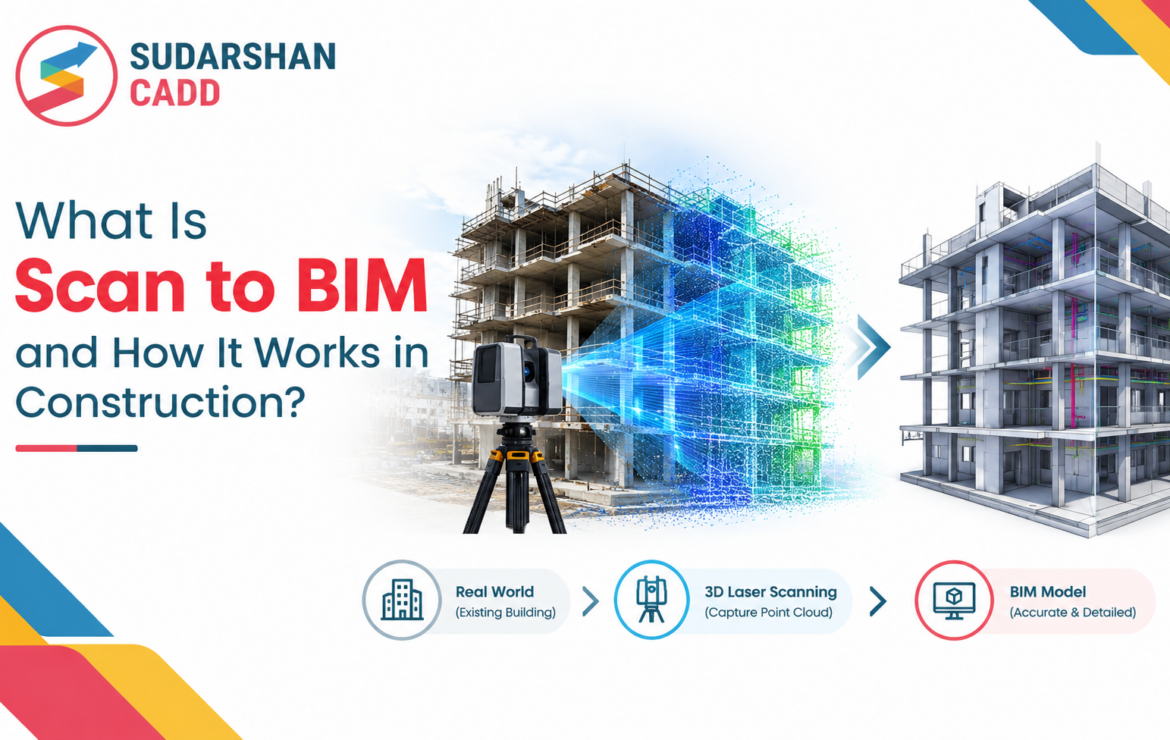
What Is Scan to BIM and How It Works in Construction?
In today’s construction world, getting things right from the start is very important. That’s where what is scan to bim becomes useful. It’s a simple idea—capture real-world building data and turn it into a digital 3D model. This helps teams clearly understand a site before making any decisions. Instead of guessing or relying only on drawings, professionals can work with accurate information. This not only saves time but also reduces costly mistakes, especially in renovation or complex projects.
Understanding Building Information Modeling (BIM) in Construction
Think of Building Information Modeling (BIM) as a smart digital version of a building. It’s not just a 3D model—it also includes important details like materials, dimensions, and systems.
In simple terms, BIM helps teams:
- See the building before it’s built
- Work together more easily
- Spot problems early
- Plan better
It makes the whole construction process more organized and clear.
Importance of 3D Visualization in Project Planning
3D visualization makes it much easier to understand a project. Instead of looking at flat drawings, you can actually “see” the building.
This helps because:
- Everyone understands the design quickly
- Mistakes are easier to find
- Communication becomes smoother
It’s like turning an idea into something you can visually explore.
Step-by-Step Overview of the Scan to BIM Process
The scan to bim process may sound technical, but it’s quite simple when broken down:
- A scanner captures the real site in detail
- The data is collected as digital points
- This data is cleaned and organized
- A 3D model is created from it
- The model is checked for accuracy
In short, it turns real-world information into a digital model you can use.
Converting Point Cloud Data into BIM Models
The point cloud to BIM step is where things start to take shape. A point cloud is just a collection of tiny data points that represent a building.
These points are used to:
- Build walls, floors, and structures
- Add details to the model
- Create a usable 3D design
It’s like connecting dots to form a complete picture.
Workflow of 3D Scan to BIM Conversion
3D scan to BIM conversion is the process of turning scanned data into a proper model using software.
This helps to:
- Capture complex building shapes
- Avoid manual measurement mistakes
- Improve overall accuracy
It ensures the model matches the real structure closely.
Role of Scan to BIM Modeling in Projects
Scan to BIM modeling is where the final model is developed with all necessary details.
Teams use it to:
- Plan construction work
- Check for clashes between systems
- Keep everything coordinated
It becomes a central reference for the whole project.
Structural Scan to BIM for Accurate Engineering
Structural scan to BIM focuses on important parts like beams, columns, and slabs.
This is helpful for:
- Checking structural strength
- Planning repairs or upgrades
- Making sure everything is safe
It gives engineers confidence in their designs.
Key Benefits of Scan to BIM in Construction
Here are some simple but powerful benefits:
- Accurate data – What you see is what actually exists
- Saves time – Less manual work needed
- Better teamwork – Everyone uses the same model
- Fewer mistakes – Problems are found early
- Cost savings – Less rework and delays
Common Applications of Scan to BIM
Scan to BIM is used in many real situations:
- Renovating old buildings
- Preserving historic structures
- Managing building maintenance
- Planning infrastructure projects
- Designing industrial spaces
It’s useful anywhere accuracy matters.
Challenges in Scan to BIM Implementation
Like any technology, it has a few challenges:
- Equipment can be expensive
- Skilled professionals are needed
- Large data files can be hard to manage
But with the right approach, these can be handled.
Future Trends in Scan to BIM Technology
The future looks exciting for scan to BIM:
- AI will speed up modeling
- Drones will make scanning easier
- Real-time updates will improve workflows
- Cloud tools will enhance collaboration
These changes will make the process faster and more accessible.
Conclusion
Scan to BIM is making construction smarter and more reliable. It helps teams understand real conditions, plan better, and avoid mistakes. As technology continues to improve, it will become even more important in the industry.
Contact us today to enhance your project planning with expert BIM solutions.